THE KEY IDEA
Understanding someone’s stage of life helps you understand the context in which they are trying to become healthier.
Imagine a woman in her forties who wants to feel more energetic and regain a sense of control over her health. Her sleep is disrupted, her periods are changing, and the routines that once worked for her no longer feel manageable. Years earlier, she experienced high blood pressure during pregnancy.
A useful coaching conversation would make room for all of this: her health history, her current experience, the demands on her time and what matters most to her.
A new framework for women’s cardiovascular health helps explain why that broader perspective matters. For anyone considering training as a health optimisation coach, it offers a compelling example of how scientific understanding can enrich the way we support people.
Heart health across a lifetime
Cardiovascular disease is the leading cause of death among women worldwide, so recognising opportunities for earlier prevention matters. 4
In October 2026, the American Heart Association and three leading US medical societies representing paediatrics, obstetrics and maternal–fetal medicine published a three-part compendium in Circulation. Drawing together existing research and expert consensus, it sets out an approach to cardiovascular prevention that follows women through the different stages of their lives. 1
Its central message is that hormonal health, psychological and social wellbeing, and cardiovascular health are interconnected. Understanding those connections can help clinicians recognise risk earlier and personalise care. 2
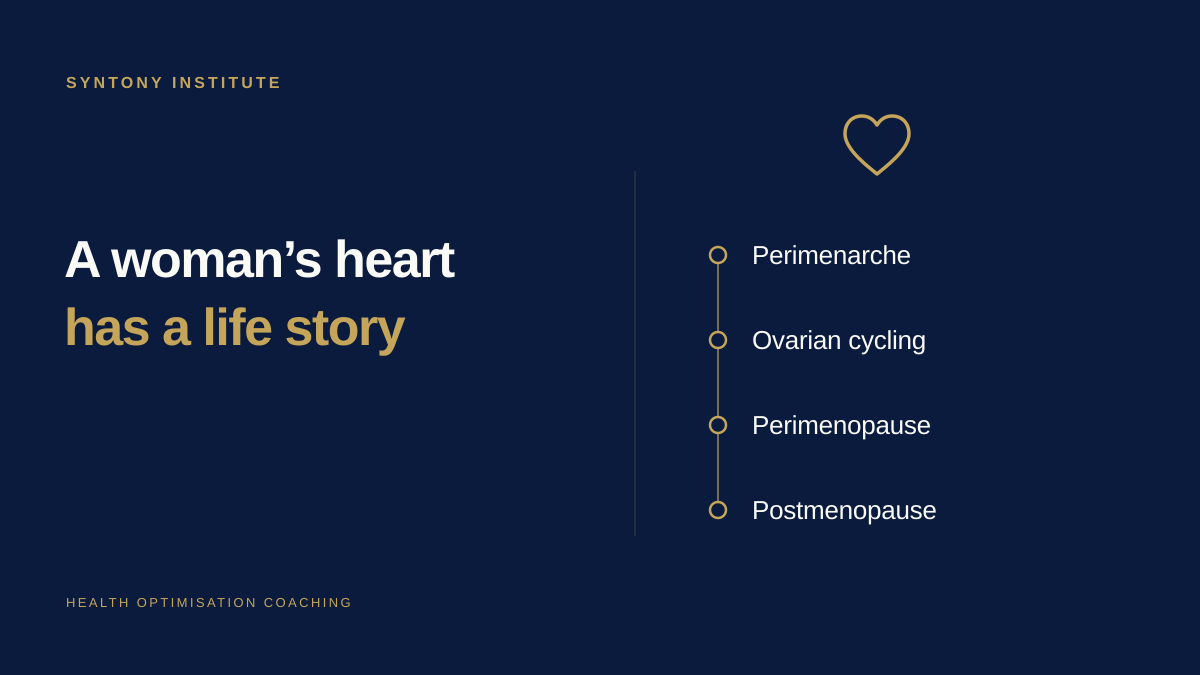
The framework describes four main stages:
| Life stage | What it means |
|---|---|
| Perimenarche | The transition around the start of menstruation. |
| Ovarian cycling | The reproductive years characterised by ovarian cycles. |
| Perimenopause | The transition towards menopause, with changing menstrual patterns. |
| Postmenopause | The years following menopause. |
These stages reflect biology rather than age alone. Childhood provides an earlier foundation, while pregnancy, when it occurs, adds another important dimension to a woman’s cardiovascular history. 2, 3
For a future coach, the practical insight is simple: understanding someone’s stage of life helps you understand the context in which they are trying to become healthier.
Three parts of a woman’s story that deserve attention
1. Menstrual health can offer useful clues
The guidance asks clinicians to recognise menstrual history as a “cardiovascular vital sign”. Changes in cycle patterns can prompt clinicians to investigate hormonal or metabolic conditions; heavy bleeding also warrants attention to possible iron deficiency. 3
For a coach, this encourages thoughtful listening. If a client describes persistent fatigue alongside heavy periods, supporting her to discuss both with a healthcare professional may be an important first step. Her experience deserves attention as she considers what changes feel realistic.
2. Pregnancy history can matter years later
Complications such as pregnancy-related high blood pressure, pre-eclampsia, gestational diabetes and preterm birth are associated with higher future cardiovascular risk. The advisory calls for these experiences to be recorded and incorporated into ongoing prevention. 4
A complication that happened years ago can therefore be useful information in a present-day health conversation. It offers an opportunity for more informed, individualised care; it does not mean that heart disease is inevitable.
A coach can help a client prepare questions for her clinician and ensure that relevant parts of her history are part of that discussion.
3. Perimenopause is an opportunity to review wider health
During the menopause transition, changes in cardiovascular and metabolic risk can occur beyond those attributable to ageing alone. 4
The consensus guidance encourages clinicians to begin asking about perimenopause and related symptoms by age 40, and to undertake a comprehensive cardiovascular risk assessment when the transition begins. 3
For someone experiencing disrupted sleep, hot flushes or changes in mood, this creates a timely opening to discuss both current wellbeing and longer-term health.
It also invites a compassionate coaching question: “What support would help you care for yourself through this stage of life?”
Where health optimisation coaching can help
The foundations of cardiovascular health remain relevant throughout life. The American Heart Association’s Life’s Essential 8 covers eating patterns, physical activity, sleep and tobacco exposure, alongside weight, blood pressure, cholesterol and blood glucose. 5
The challenge is making those foundations workable in everyday life.
A woman may value regular movement but struggle to find time while caring for a parent. She may want more consistent meals but work unpredictable hours. She may understand the importance of sleep while feeling unable to switch off at the end of the day.
A useful plan has to account for her energy, resources, responsibilities and preferences.
This is where the art of coaching comes into focus: listening carefully, helping someone clarify what matters, exploring barriers and supporting steps they choose and can sustain. These are central features of professional health coaching. 6
Turning understanding into practical action
Return to the woman at the beginning of this article. A coaching conversation could help her identify a manageable next step.
Alongside encouraging an appropriate clinical review of her symptoms and pregnancy history, a coach could explore:
- Her priorities: “What would feeling healthier allow you to do or enjoy?”
- Her current reality: “What is making it difficult to look after yourself at the moment?”
- Her strengths: “When have you successfully made space for your health before?”
- Her next step: “What feels useful and achievable this week?”
She might choose a short walk with a friend twice a week, a more workable evening routine, or asking her family for help with a responsibility that regularly leaves her exhausted. She might also prepare a short list of questions for her next medical appointment.
The coach then helps her review what happened, learn from the experience and adjust.
The value lies in making change personal, practical and responsive to her life.
Clinical risk assessment, diagnosis, interpretation of medical tests and decisions about medication or hormone therapy remain with appropriately qualified healthcare professionals. A coach’s contribution is to support informed choices and sustainable action within their professional scope. 6
The mind–body connection belongs in this conversation
One of the most relevant features of the new framework is its explicit attention to psychological and social wellbeing alongside hormonal and cardiovascular health. 2
That perspective matters when you are learning to coach.
A client’s confidence, emotional experience, relationships and available support all deserve space in a conversation about change. So do practical realities such as finances, working hours and access to healthcare.
For the aspiring coach, this is an invitation to develop both scientific literacy and the ability to listen without rushing to a solution. You need to understand the health landscape well enough to ask useful questions, while remaining curious about the person in front of you.
Learning to see the whole picture
This is the kind of thinking that informs Syntony Institute’s Health Optimisation Coach Training.
Our programme brings together mind–body health science, functional longevity, personal development and professional coaching skills. You explore areas including nutrition, sleep, metabolic health and psychological wellbeing, while developing your ability to listen, ask effective questions and support behaviour change through practical coaching experience. 7
If you feel drawn to helping people understand themselves, navigate change and take meaningful steps towards better health, this work offers a way to bring that interest into professional practice.
A woman’s heart health has a life story. Learning to listen to that story, recognise when clinical input is needed and support realistic action is part of becoming a thoughtful, capable health optimisation coach.
Explore Syntony Institute’s Health Optimisation Coach Training and download the curriculum guide.
Sources and further reading
- [1] American Heart Association: announcement of the three-part compendium, 26 October 2026
- [2] American Heart Association: Cardiovascular Health in Girls and Women Compendium
- [3] American Heart Association: key points from the consensus guidance
- [4] American Heart Association: key points from the presidential advisory
- [5] American Heart Association: Life’s Essential 8
- [6] National Board for Health & Wellness Coaching: scope of practice
- [7] Syntony Institute: Health Optimisation Coach Training
- Original scientific statement in Circulation (2026)
- Original presidential advisory in Circulation (2026)
Sources reviewed on 23 November 2026.
ABOUT THIS SERIES
Produced by Syntony Institute from our current Health Optimisation Coach Training curriculum and Health Coaching 3.0 framework, developed by Dr Mark Atkinson, Co-Founder & Chief Training Officer. These guides explain training and professional practice; they do not provide individual medical advice.
Meet Syntony Institute