THE KEY IDEA
Health Coaching 3.0™ is Syntony Institute's framework for personalised mind-body health optimisation. It brings contemporary health knowledge together with advanced coaching, behaviour change, health-data literacy and human development.
Why bring these capabilities together?
A prospective client may arrive with a sleep score, a list of supplements and several ideas from health podcasts. At the same time, they may be working long hours, struggling to recover and unsure where to begin.
The coach's task is to understand the person and help identify a meaningful way forward. Knowing more about health can help, but it needs to be used with judgement, context and an ability to support change.
Health Coaching 3.0™ is Syntony Institute's framework for this work. It builds on the essential skills of professional coaching and whole-person behaviour change, expanding the knowledge and capabilities taught for contemporary health optimisation. The numbered framework expresses Syntony's approach; it is not a universal classification or regulatory standard for the profession.
A worked example of the coaching process
Consider an illustrative client who wants to feel stronger, recover better and remain capable as they age. They have accumulated advice but have not developed a manageable plan.
They are not asking for a prediction of how long they will live. They want the capacity to work well, enjoy relationships, travel and keep doing valued activities. This distinction helps make functional longevity relevant to everyday life.
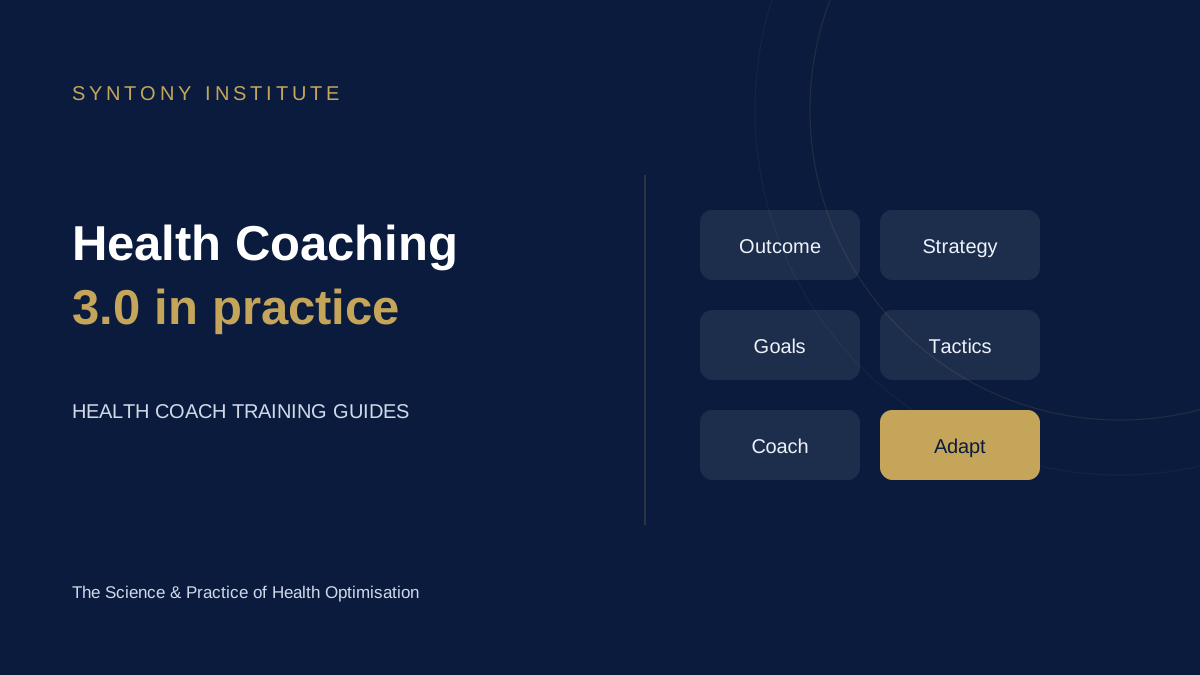
Syntony's Health Optimisation Coaching System organises the work through six connected stages: Outcome → Strategy → Goals → Tactics → Coach → Adapt. These stages provide structure while leaving room for the person's circumstances, preferences and learning.
Outcome: understand what better health is for
Start with the desired outcome. What would becoming stronger and recovering better enable the client to do? Why does it matter now? What would meaningful progress look like from their perspective?
The answer helps prevent the plan from becoming a collection of attractive interventions. A person who wants enough capacity for active family life may need a different starting point from someone preparing for a demanding sporting event.
At this stage, the coach also explores the client's experience, priorities, constraints and relevant professional support. Medical symptoms or concerns are directed to an appropriately qualified healthcare professional.
Strategy and goals: choose the priorities
A strategy identifies a coherent overall approach. It might involve creating more reliable recovery opportunities and establishing a realistic foundation of movement before adding complexity.
The client and coach then translate the strategy into goals. For our illustrative client, this could mean developing a sustainable activity routine and a more consistent evening pattern. The goals should reflect what is meaningful and feasible, with specialist input where needed.
Contemporary health literacy helps a coach ask informed questions about sleep, nutrition, training load, recovery and daily demands. It should also help them recognise when more information would add little. Personalisation includes deciding what to leave for later.
Tactics: select actions that fit the person
Tactics are the practical actions used to support the goals. These could include planning when movement will happen, changing an environmental cue or agreeing a manageable wind-down routine.
The same tactic will not fit everyone. A demanding exercise schedule may be unrealistic for someone with unpredictable caring responsibilities. A sophisticated tracking system may create more burden than insight for another client.
The coach helps the client explore options, understand relevant principles and choose an experiment. Where a qualified professional has provided clinical or specialist recommendations, the coach can support their implementation without changing the professional's remit.
Coach: work with what makes implementation difficult
This stage is where the relationship matters. The client may encounter competing demands, discouragement, automatic habits or a belief that a partial effort does not count.
A skilful conversation can help them notice these patterns and consider a more workable response. Appropriate non-clinical practices may support self-awareness, recovery or regulation of arousal. The coach can also help the client examine thoughts and emotions without treating them as facts that must determine the next action.
Syntony calls attention to this inner dimension because health behaviour happens within a person's lived experience. Working with everyday self-management remains distinct from psychotherapy, trauma treatment or diagnosis of mental-health conditions.
Adapt: learn from experience and relevant data
At review, the coach and client examine what actually happened. Which actions fitted? What was difficult? What did the client notice about energy, confidence, recovery and daily functioning?
Wearables or other non-diagnostic measures may contribute useful context. They should be considered alongside the person's experience, the limitations of the measurement and trends over time. A single score should not determine the entire story.
The plan is adjusted in response. An action may need to become smaller, move to a different part of the day or be replaced. Adaptation is part of the method, rather than evidence that the person has failed.
The professional role remains Health Optimisation Coach
Health Coaching 3.0 brings together advanced coaching, behaviour and habit change, nervous-system regulation, mind management, health assessment and biomarker literacy, physical and cognitive capability, functional longevity, wearables, supplements, health technologies and professional collaboration.
These areas broaden the context a coach can understand. They do not grant clinical permissions. The role remains to educate, coach, personalise, support implementation, monitor progress, collaborate and refer within competence.
Our programme trains Health Optimisation Coaches. Successful completion leads to the credential Certified Health Optimisation Coach. Functional longevity is an important part of the learning, rather than a separate professional title we award.
How this shapes the training
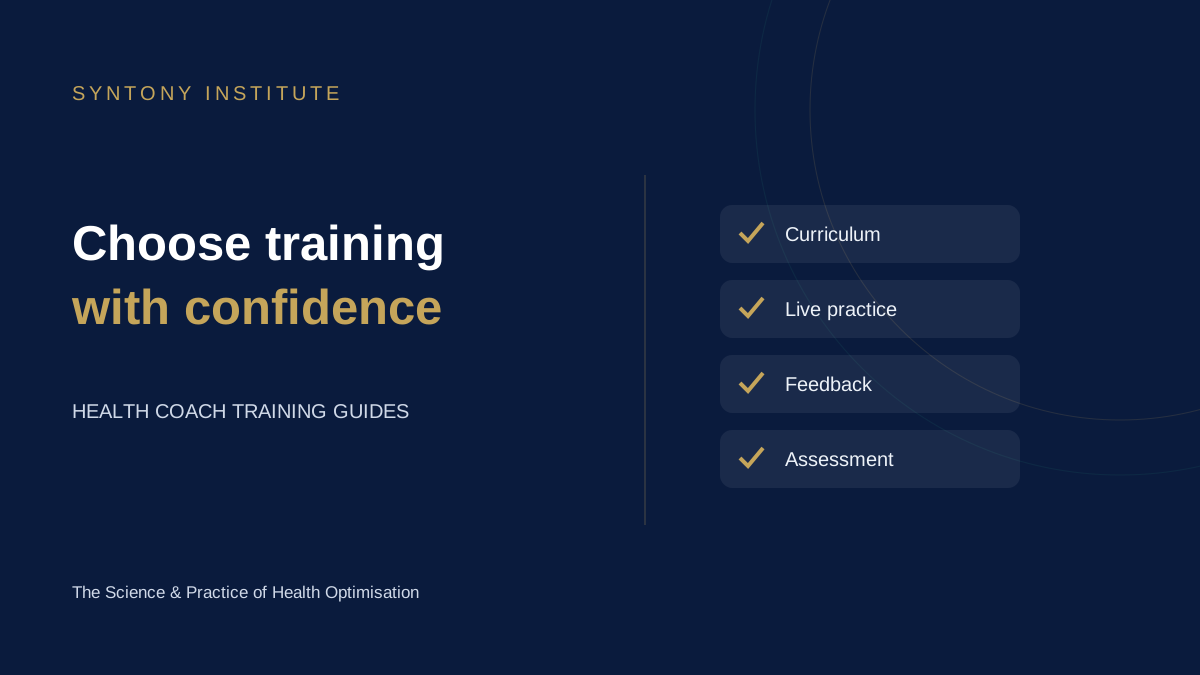
Syntony's pathway begins with the experiential Thrive Unlimited foundation, so students apply appropriate practices to their own lives. It then combines the 12-module curriculum with live skills training, coaching practice, feedback and competency assessment.
The aim is to develop understanding and practical capability together. Students need to be able to assess the relevance of information, see the person in context and work skilfully through a real conversation.
Read the full Health Coaching 3.0 framework, explore the Health Optimisation Coach Training Programme or join an Open House. If you are comparing pathways, our course selection guide offers useful questions to bring. Still deciding whether coaching is right for you? Take our five-question Coaching Readiness Guide for a personalised next step.
Common questions
Is Health Coaching 3.0 a separate regulated profession?
Health Coaching 3.0 is Syntony Institute's framework for personalised mind-body health optimisation, not a universal regulatory classification.
What credential will I receive?
Successful completion leads to the Certified Health Optimisation Coach credential, awarded by Syntony Institute. Functional longevity is part of the curriculum.
ABOUT THIS SERIES
Produced by Syntony Institute from our current Health Optimisation Coach Training curriculum and Health Coaching 3.0 framework, developed by Dr Mark Atkinson, Co-Founder & Chief Training Officer. These guides explain training and professional practice; they do not provide individual medical advice.
Meet Syntony Institute